Why Freshwater Shortages Will Cause The Next Great Global Crisis March 10th, 2015
Via The Guardian, an interesting yet sobering look at why freshwater shortages will cause the next global crisis:
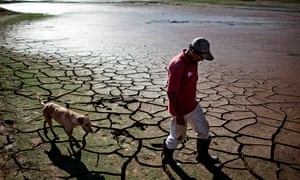
The drying Paraibuna dam, part of the Cantareira water system that provides greater São Paulo in Brazil with most of its water.
Last week in the Brazilian city of São Paulo, home to 20 million people, and once known as the City of Drizzle,drought got so bad that residents began drilling through basement floors and car parks to try to reach groundwater. City officials warned last week that rationing of supplies was likely soon. Citizens might have access to water for only two days a week, they added.
In California, officials have revealed that the state has entered its fourth year of drought with January this year becoming the driest since meteorological records began. At the same time, per capita water use has continued to rise.
In the Middle East, swaths of countryside have been reduced to desert because of overuse of water. Iran is one of the most severely affected. Heavy overconsumption, coupled with poor rainfall, have ravaged its water resources and devastated its agricultural output. Similarly, the United Arab Emirates is now investing in desalination plants and waste water treatment units because it lacks fresh water. As crown prince General Sheikh Mohammed bin Zayed al-Nahyan admitted: “For us, water is [now] more important than oil.”
Water stress and climate change
The global nature of the crisis is underlined in similar reports from other regions. In south Asia, for example, there have been massive losses of groundwater, which has been pumped up with reckless lack of control over the past decade. About 600 million people live on the 2,000km area that extends from eastern Pakistan, across the hot dry plains of northern India and into Bangladesh, and the land is the most intensely irrigated in the world. Up to 75% of farmers rely on pumped groundwater to water their crops and water use is intensifying – at the same time that satellite images shows supplies are shrinking alarmingly.
The nature of the problem is revealed by US Geological Survey figures, which show that the total amount of fresh water on Earth comes to about 2,551,100 cubic miles. Combined into a single droplet, this would produce a sphere with a diameter of about 170 miles. However, 99% of that sphere would be made up of groundwater, much of which is not accessible. By contrast, the total volume from lakes and rivers, humanity’s main source of fresh water, produces a sphere that is a mere 35 miles in diameter. That little blue droplet sustains most of the people on Earth – and it is under increasing assault as the planet heats up.
Changing precipitation and melting snow and ice are already altering hydrological systems in many regions. Glaciers continue to shrink worldwide, affecting villages and towns downstream. The result, says the Intergovernmental Panel for Climate Change, is that the fraction of global population experiencing water scarcity is destined to increase throughout the 21st century. More and more, people andnations will have to compete for resources. An international dispute between Egypt and Ethiopia over the latter’s plans to dam the Nile has only recently been resolved. In future, far more serious conflicts are likely to erupt as the planet dries up.Even in high latitudes, the one region on Earth where rainfall is likely to intensify in coming years, climate change will still reduce water quality and pose risks due to a number of factors: rising temperatures; increased levels of sediments, nutrients, and pollutants triggered by heavy rainfall; and disruption of treatment facilities during floods. The world faces a water crisis that will touch every part of the globe, a point that has been stressed by Jean Chrétien, former Canadian prime minister and co-chair of the InterAction Council. “The future political impact of water scarcity may be devastating,” he said. “Using water the way we have in the past simply will not sustain humanity in future.”
This entry was posted on
Tuesday, March 10th, 2015 at
2:19 pm and is filed under
News. You can follow any responses to this entry through the
RSS 2.0 feed.
You can leave a response, or trackback from your own site.